Fen Edge Festival 2026

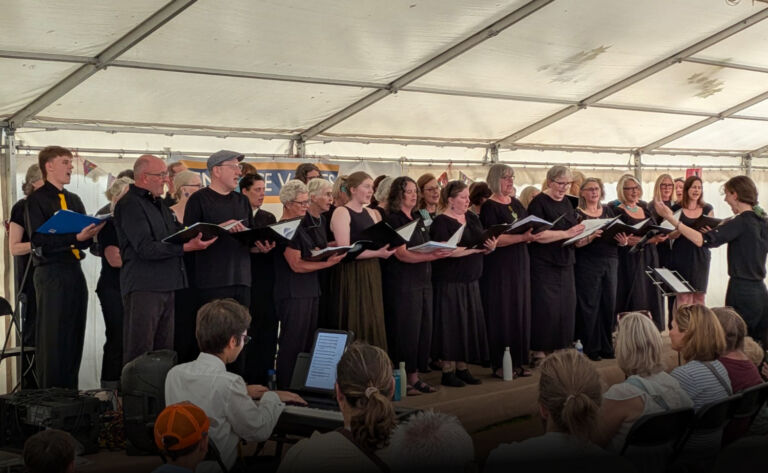
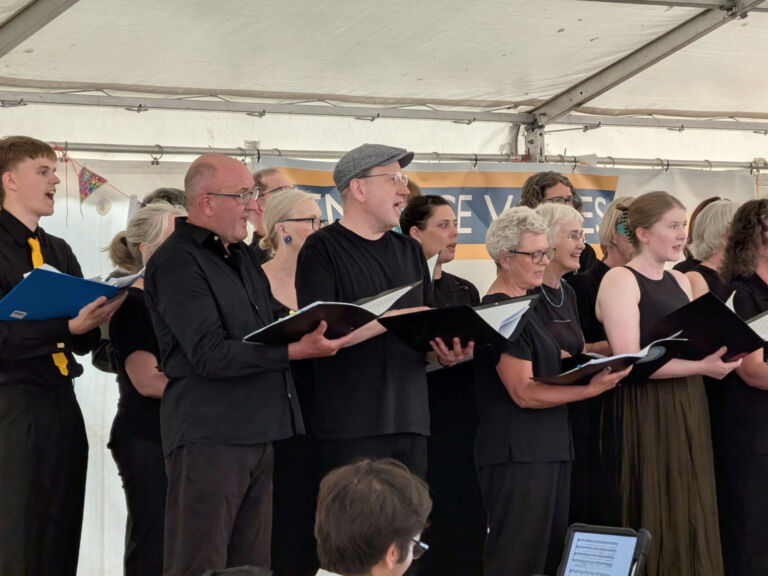
It’s safe to say that FEV went down a storm on the Sunday of the 2026 Fen Edge Festival in Cottenham for the choir’s very first concert; that’s what the audience response and feedback would suggest. Led by our MD Jazz and accompanied by Rich on piano, the sound the choir projected with a small, but perfectly formed, set was, audience members told us, amazing. So, thank you to every FEV choir member who sang and for the kind words from members who couldn’t make it.

Photos by Matthew Bradley
Fen Edge Voices in full performance mode (Photo: Matthew Bradley)

It’s been a whirlwind these last few months, from the pre-choir weeks of recruiting our MD and pianist and our pulling a committee together to get things started with all the necessary logistical and administrative stuff.

We’ve had great support from the Cottenham Community Centre where we rehearse, so a massive thank you to the Trustees there and especially to CCC Treasurer Steve Poole for his financial advice and assistance and his shelf-building skills.

Thanks also to our two grant providers for funds that helped us buy necessary equipment, such as our piano and the shelf materials, and to cover various other costs. They both helped us get started with a firm financial foundation. That’s Cambridgeshire County Council’s Community Reach Fund and CPSL Mind’s Good Life Fund.

Thanks also to Cottenham bespoke printing company Screen & Graphics for taking our design and scaling it up to print a huge and wonderful banner for us entirely for free. We proudly displayed it yesterday and will use it for years to come as the Fen Edge Voices community choir matures.

Finally, thank you to everyone who watched our first performance, for your applause, your smiles, and your singing along!

Photo by Matthew Bradley

Choral Chords

In rehearsal, we’re often asked to stop on a chord and hold it, usually on a final word or vowel. The text doesn’t matter; the harmony does.

Sometimes it sounds right immediately. Sometimes it needs work. Occasionally, it clashes. Why?

We usually sing in four parts, Soprano, Alto, Tenor, Bass, sometimes split further. Each section sings a different note, combining into a chord. If the notes align in tune and balance, the chord blends into a single sound.

When harmony works, it’s clear and satisfying. When it doesn’t, it can feel unstable, but rehearsal is where we fix that.

Most listeners recognise the difference between chords that feel “finished” (major or minor) and those that create tension (such as suspended or diminished chords). Songs move between tension and resolution, often using a mix of chord types.

In choir, some notes come from the accompaniment, while the voices provide the core harmony. Basses often anchor the chord, inner parts (altos and tenors) fill in colour and tension, and sopranos typically carry the melody.

Occasionally, a chord “locks in”, it feels fuller, clearer, and easier to sing. This happens when everyone holds their note steadily, listens across the choir, and tunes their voices carefully together.

A note may sound “wrong” on its own but be correct in context. Composers often use dissonance deliberately, resolving it later. The key is confidence: hold your note and trust the harmony.

Inner parts can feel especially exposed, as their notes may seem unusual in isolation. In pieces like California Dreamin’ or Seal Lullaby, these lines are essential to the overall sound. Don’t adjust them to feel safer, sing them accurately and let the harmony work.

Note lengths

A very short appendix to our introduction to musical notation explaining the relationship between note lengths.

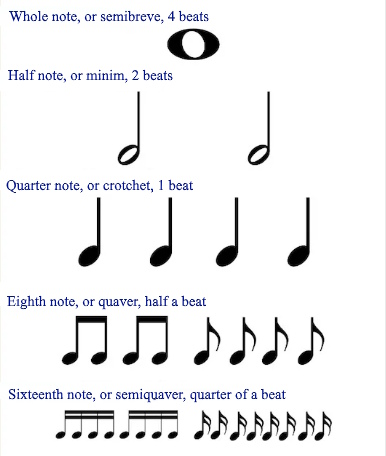
The semibreve is a whole note, it lasts for four beats. The minim, is a half note, and lasts for two beats. Two minims add up to a semibreve.

The crotchet, or quarter note, lasts for one beat, so two of those add up to a minim, four add up to a semibreve. So in 4/4 time they’re your count of 1, 2, 3, 4

Quavers are eighth notes, each is half the length of a crotchet. You need 8 of those to add up to the duration of a semibreve. You might count them as 1-and-2-and-3-and-4-and…

Semiquaver are half the length of the quavers, so there are 16 needed to add up to a semibreve, whole note. They have two tails on the individual notes.

Rests

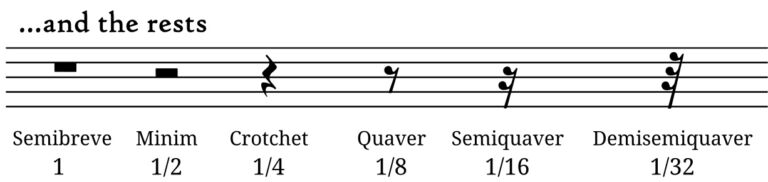
Each note length also has an equivalent “rest”. A rest is simply a bit where you don’t sing, your part, or sometimes, other parts are quiet wherever there’s a rest marked in your sheet music.

Dotted notes

If you see a dot immediately to the right of a note, then that means you hold the note for 50 percent of its value longer. So a dotted minim lasts 3 beats instead of 2, a dotted crotchet lasts one and a half beats, instead of 1, a dotted quaver lasts three quarters of a beat, and so on.

Even shorter notes

Oh, I’ve not put them in the diagram above, but we can have notes that are half the length of the semiquavers, these 32nd notes are called demisemiquavers and have three tails on the individual notes And, as you might have guessed, half again are 64th notes, hemidemisemiquavers, four tails.


Repeats and returns


Many of the songs we sing include repeats, variations, and sometimes a final section (a coda). It can look complicated, but the sheet music, and the MD, guide you.

In four-part harmony, the staves are arranged from top to bottom as soprano, alto, tenor, and bass. These are sometimes paired (SA and TB). Beneath them, you may see two additional staves for piano accompaniment (right hand above left).

Repeats and navigation

A repeat sign (:||) tells you to go back. If there’s a matching sign (||:) earlier, return to that point; otherwise, go back to the start (the top).

First and second endings

Some sections have different endings on each repeat. These are marked with numbered brackets. The first time, sing the “1” ending, then go back. The second time, skip it and move to the “2” ending.

D.C. and D.S.

For longer jumps, composers use shortcuts:

  • D.C. (Da Capo): go back to the beginning.
  • D.S. (Dal Segno): go back to the stylised S sign (𝄋).

Endings

A double bar line marks the end. You may also see Fine, meaning “finish.” Instructions like D.C. al Fine mean return to the start and stop when you get to “Fine.”

Coda

Some pieces end with a coda, a separate closing section. Look for the coda symbol (a circle with a cross through it, like a little target 𝄌). Instructions like D.S. al Coda mean go back to the sign, continue until the coda symbol, then jump to the coda.

Vocal health

Now that we’re warming up musically, here are some essentials of vocal health, focusing on facts rather than myths.

Your voice is part of your body, so how you treat your body affects how you sound.

Nothing you swallow touches your vocal cords

Your vocal cords (vocal folds) sit in the larynx, inside the airway. Food and drink don’t reach them. If they did, you’d cough rather than sing.

Warm drinks like honey and lemon can feel soothing, and lozenges may ease the throat or clear the nose. However, menthol-based lozenges can be drying, so are best avoided before singing.

Hydration matters, early

Good hydration supports vocal function, but it isn’t immediate. Drink regularly throughout the day, especially before rehearsal or performance, to allow your body time to hydrate properly. There’s no need to overdo it, just stay consistently well hydrated.

Dairy and chocolate

Dairy doesn’t increase mucus, but it can thicken saliva, making you feel the need to clear your throat more often. Chocolate can have a similar effect. It’s best to avoid both close to singing.

Vocal recovery

After singing, or if your voice feels tired, the most effective remedy is hydration and rest. Silence helps your vocal folds recover. If you’ve been talking all day, aim for at least 20 minutes of quiet before rehearsal.

Avoid strain

Frequent throat clearing can irritate the vocal folds. Instead, try a gentle, silent cough and sip water.

Be cautious with lozenges: glycerin-based ones can soothe, while menthol-based ones may dry the throat.

The golden rule

Singing should not hurt. If it does, stop. Check your posture, breathe, and ease off. If certain notes consistently cause strain, they may be outside your comfortable range.

Your section isn’t fixed. You may find some songs sit better in a different part, and adjustments can be made if needed. Our MD can help you find a range and placement that allows you to sing comfortably and confidently.

A glossary of musical terms

Finding your way around music

  • SATB
    The standard abbreviation for the four voice parts: Soprano, Alto, Tenor, and Bass.
  • Staff / System
    The lines music is written on / A group of staves sung at the same time, the SATB parts often shown about the left- and right-hand of the piano parts.
  • Measure (Bar)
    The space between two vertical lines that groups beats together.
  • Unison
    When everyone sings the exact same pitch at the same time.
  • A Cappella
    Singing without any instrumental accompaniment, literally Italian for in the chapel.
  • Coda
    The concluding passage of a piece; the “final tail” of the music.
  • Dal Segno (D.S.)
    An instruction to go back to the “sign” (a stylized S symbol) and repeat from there, often before going to the coda.
  • Key Signature
    The group of sharps or flats at the start of each staff that tells you which scale to use.
  • Repeat Sign
    Double bar lines with two dots indicating that the section of music should be performed again.
  • Time Signature
    The two numbers at the start of a piece (e.g., 4/4) that tell you how many beats are in each measure.
  • Da Capo (D.C.)
    An instruction to return to the very beginning (the “head” or top) of the piece.
  • Clef
    The symbol at the start of the staff (Treble or Bass) that fixes the pitch of the notes.
  • Interval
    The gap between notes in terms of their pitch, how much higher or lower one note is than another. We have a detailed article about musical intervals.
  • Score
    The complete script of the music, showing all voice parts and instrumental accompaniments together. We have a more detailed article about musical notation.

Tempo & Rhythm

  • Tempo
    The speed of the music.
  • Allegro / Andante / Adagio
    Fast / Moderate “walking” pace / Slow.
  • Ritardando (rit.)
    Gradually slowing down the speed, common at the end of a piece of music or before a rousing chorus.
  • A Tempo
    Instruction to return to the original speed (usually after a ritardando).
  • Moderato
    A medium or moderate tempo, faster than Andante but slower than Allegro.
  • Accelerando (accel.)
    The opposite of a ritardando; gradually getting faster and faster.
  • Largo
    A very slow and broad tempo, even slower than Adagio.
  • Presto
    Very fast; a speed quicker than Allegro.
  • Beat
    The steady pulse of the music that you might tap your foot to.
  • Rubato
    “Robbed time”; a flexible approach to tempo where the musical director pulls and pushes the tempo for expressive effect.
  • Syncopation
    Rhythms that place the accent on the “weak” beats or between the beats. You can think of it as making the piece sound jazzier or funkier, but it also applies to classical and other genres.

Dynamics & Volume

  • We have a longer article about the choir’s volume control
  • Piano (p) / Forte (f)
    Soft volume / Loud volume.
  • Crescendo / Decrescendo
    Gradually getting louder / Gradually getting softer.
  • Mezzo-Forte (mf) / Mezzo-Piano (mp)
    Medium-loud / Medium-soft. The “middle ground” of choral singing.
  • Pianissimo (pp) / Fortissimo (ff)
    Very soft / Very loud.
  • Diminuendo (dim.)
    Another term for decrescendo—slowly fading the volume.
  • Forte-Piano (fp)
    Loud, then immediately soft.

Technique

  • Legato / Staccato
    Smooth and connected / Short and detached.
  • Intonation
    Singing accurately “in tune.” The opposite is known colloquially as pitchiness.
  • Phrasing
    The musical “sentences”; deciding where to breathe and shape a line.
  • Tutti
    Italian for “all”; indicates that the full choir should sing after a solo or small group section.
  • Breath Support
    The use of the diaphragm to control air flow for steady, long, and powerful notes.
  • Staggered Breathing
    A technique where choir members breathe at different times so the collective sound never stops.
  • Vibrato
    A slight, rapid fluctuation in pitch that adds warmth and richness to the voice.
  • Chest Voice / Head Voice
    The lower, powerful singing range / The higher, lighter, and more resonant singing range. We have a more complete article about vocal range and vocal technique.
  • Enunciation
    The clear and distinct pronunciation of words so the audience can understand the text.

Dynamics: the choral volume control

The music and the musical director should be in full control of how a choir sounds. The sheet music guides the singers, but the MD is giving us the tempo, the pulse, the expression. All eyes on the MD and a choir can’t go wrong. There are some abbreviations and markings on sheet music that can help. Knowing what these mean will help you follow the MD much more effectively.

Musical notation, vocal range and SATB, intervals, and other stuff are covered elsewhere in the FEV Notes, but here’s a table showing the choir’s volume control. The two anchor words are piano (soft/quiet) and forte (strong/loud).

Symbol Italian Word Meaning
pp Pianissimo Very soft
p Piano Soft
mp Mezzo-piano Moderately soft
mf Mezzo-forte Moderately loud
f Forte Loud; strong and bold
ff Fortissimo Very loud; full power

Sections will be marked according to how the composer or the arranger, which might be the MD, wants a part to be sung. There might also be other markings that transition from quiet to loud (a crescendo, cresc.) sections or loud or soft (diminuendo, dim.). A crescendo is often marked with what is known colloquially as a hairpin, two long angled lines <. A diminuendo uses the hairpin but flipped backwards so that’s a long >. These marks can span a bar or several bars.

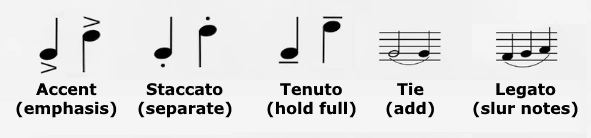
There might also be additional markings on specific notes (see the diagram above). An arrow, much shorter than the cresc./dim. hairpins, above or below a note tells you to give it more attack, to make the start of the note tighter, punchier.

A little dot above a note (or sometimes below it, depending on layout) tells us it is to be sung staccato (punchy, shorter than the usual length.

If there is a little dash above or below a note, it tells you to give it a bit extra, to hold it slightly longer than its marked rhythm, such a marking will be used to guide syncopation, where beat and rhythm are stretched and squashed to give the music the desired emotional impact.

A curved line joining notes together is called a tie. If it joins two notes of the same pitch, then you basically hold the note longer. If it joins two notes of different pitch, then it’s called a slur, and you are to steadily change the pitch from the first note to that of the next, you slide up or down to the second note.

Bonus marking: a small arrow pointing upwards (a caret) above a note tells you to basically make the note as punchy as possible, if not shout it!

Part of what individual members of a choir should be aiming for in following the MD and the sheet music is for their voice to blend with their section and for each section to work together to project the melodies and the harmonies. Unless there are solos in a choral piece, no voice should be heard above the others, and everyone’s voice should have a place in the overall sound. This is referred to as ensemble awareness.

The Do-Re-Mi of musical intervals

The “Do–Re–Mi” song from The Sound of Music is a simple way to introduce the musical alphabet: A to G. On a piano, the white keys represent these notes, while the black keys are sharps and flats (the notes in between).

In the key of C, the major scale follows the familiar pattern:
Do–Re–Mi–Fa–Sol–La–Ti–Do = C–D–E–F–G–A–B–C.

Keeping the pattern

To start a major scale on a different note, you must keep the same pattern of intervals (gaps between notes). This often requires sharps or flats.

  • D major: D–E–F#–G–A–B–C#–D
  • F major: F–G–A–Bb–C–D–E–F
  • B major: B–C#–D#–E–F#–G#–A#–B

Each uses a different combination of black keys to preserve the same sound.

Intervals

An interval is the distance between two notes. The simplest example is an octave—from one note to the next of the same name (e.g. C to C).

Intervals are named by how far apart the notes are:

  • 2nd (Do–Re)
  • 3rd (Do–Mi)
  • up to 8th (octave)

They can also be:

  • Major (larger)
  • Minor (slightly smaller)
  • Perfect (neutral, e.g. octave)

Recognising intervals

Melodies use intervals in many combinations, not just stepwise scales. A few familiar examples:

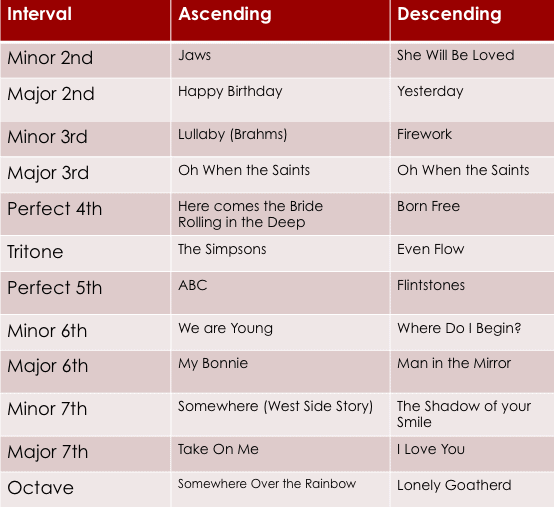
  • Semitone (minor 2nd): Jaws theme (E–F)
  • Major 2nd: “Happy Birthday” (Do–Re up), Mary Had a Little Lamb (descending)
  • Minor 3rd: “So Long, Farewell” (up), Frosty the Snowman (down)
  • Octave: “Somewhere Over the Rainbow” (opening leap)

The tritone (e.g. F to B) creates strong tension and is widely used across genres.

Unison

If everyone sings or plays the same note, there is no interval—this is called unison.

Here’s a nice cheatsheet for musical intervals. This one from mastering.com:

Musical intervals cheatsheet

A PDF version of another cheatsheet can be found here. The one below is from anneku.com

Interval cheatsheet
Interval cheatsheet where m means minor, M means major, P is for perfect.

If some of those tunes aren’t familiar, then a quick search for musical interval cheatsheet will bring up similar charts with lots of other examples.

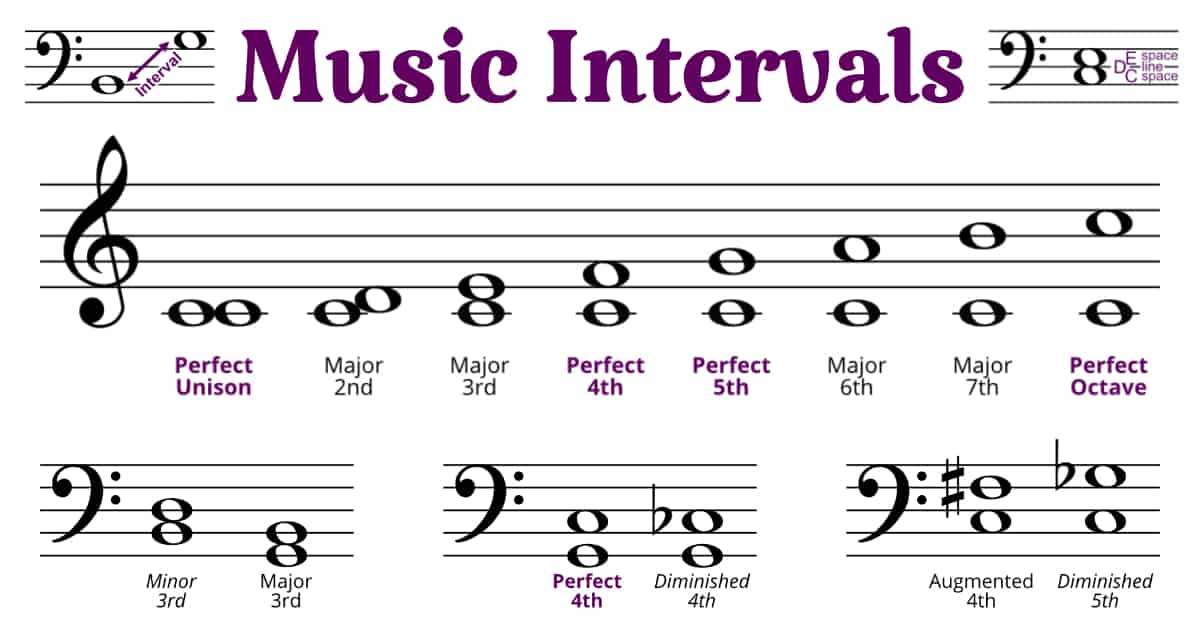
Here’s a quick summary in musical notation of the various intervals, from musicandtheory.com

Musical intervals
Musical intervals


Musical notation

As we are using sheet music here is a brief introduction, or refresher, to musical notation. Some of you will be competent sight readers and might want to dive straight into a song, others may know a bit about it, and some members may not have encountered musical notation before. Musical notation is just a way of writing down what notes to sing, how high or low they should be and how long each note is held to fit with the words of the song.
For choir music, we’re usually split into four sections – sopranos, altos, tenors, and basses. It’s commonly the women who are the “sops” and altos in a mixed choir, and the men are the tenors and basses. Some altos with a lower vocal range can quite happily sing the tenor parts. Some of the men will actually be baritones and sing somewhere in the middle of bass and tenor, not getting quite as low as the deepest bass note, nor as high as the highest tenor. More on vocal range here.

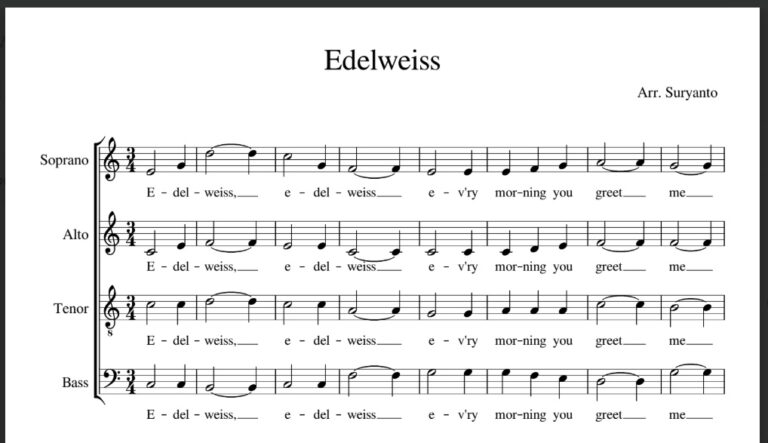
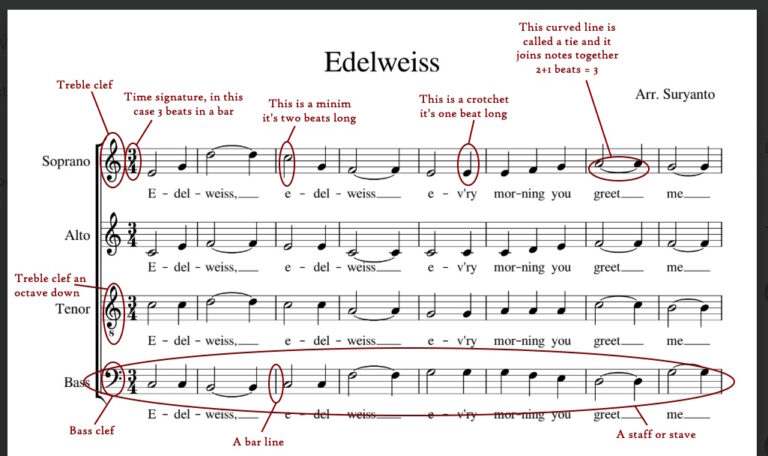
Anyway, the sheet music for a choir will usually have four sets of lines, the top five lines are for the sopranos, the five lines, known as a staff or stave, below that are for the altos. Those two staves will have a squiggly mark at the start of each called a treble clef. The two staves below those are for the tenors and the basses, and they have a backward C-shaped mark with two dots called a bass clef. The tenor stave is above the bass, because it’s higher. Sometimes, the tenor stave will have the treble clef squiggle with a little 8 underneath, which means it’s an octave lower, 8 whole notes in an octave.

So, top to bottom, we have four staves, each made up of five lines, for the soprano, alto, tenor, and bass parts. On those lines, we put marks, the notes, to correspond with the words we’re going to sing. Where those notes sit on the different lines of the staves represents how high or low the note is. Right at the top is the highest soprano note, it will even be drawn on with an extra couple of lines above the main five to show just how high it is. Right at the bottom is the deepest bass note, and again there will be extra lines drawn in below the usual bass five lines to represent exactly how low that note really is.

In between that low and that high are all the other notes, the doh-re-mi-fa-sol-la-ti-doh-re-mi-fa-sol-la…and so on getting higher and higher from bottom to top. Now, a quick aside, the doh-re-mi of the song, is like the C-D-E-F-G-A-B-C of the scale, but by calling them doh-re-mi instead, we can start our scale on a different note depending on the key of the song.

Where each note sits on a line or in between two lines in the stave tells us its pitch, how high or low it is. If you played this on the piano, you’d be using just the white notes. We’ll talk about the black notes, the notes in between the whites, the sharps and flats, another time.
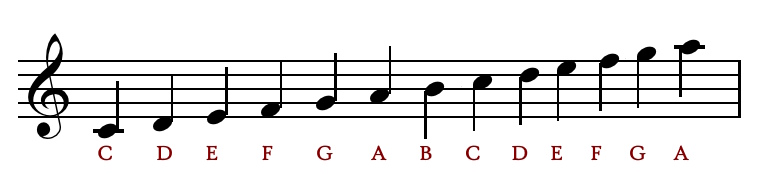
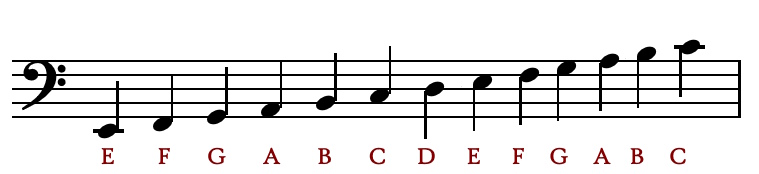
But, we need to know a little bit more about those dots and sticks on the packs of five lines, the staves, above the words of the song. If the position of the note up and down represents how high or low it is, then the shape of the note and whether it’s filled in or has a little tail on its stick represent how long the note is. If you take a look at this section of our sheet music for Edelweiss, I’ve marked it up to show you what the different terms I’ve used above refer to. I’ve separated out note lengths into a separate article, but they’re shown in the diagram below too.
TIME SIGNATURES

You might have spotted that some tunes, have a couple of numbers are the start of the staves For Edelweiss, there’s a 3 over a 4, that’s the song’s time signature, said out loud as 3 over 4, or just 3-4. This means there are three beats in the bar. The vertical lines in each stave, the bar lines (sometimes numbered), split the stave into bars and the notes within have to add up to the time signature. So, for Edelweiss, we can imagine tapping boom-cha-cha, across each bar as we sing the song, you’d get the feeling that it’s a waltz.

There are lots of basic time signatures, so 3 over 4 (three-four time) is waltz time, as we’ve seen. 2 over 4, is like a march – boom-cha, boom-cha… or left-right-left-right… if you like.

4 over 4, or 4-4, is the time signature that a lot of pop and rock are played in, the beats emphasised at different points in the bar for different styles, dance, reggae, heavy rock, whatever.

In classical choral music, you might encounter various other time signatures 3 over 8, 6 over 8 (which can be a folky kind of rhythm, as in The House of the Rising Sun.

There’s also 5 over 4, which is a compound time signature, it’s almost like a 2 over 4 with a 3 over 4 one after the other, like the Dave Brubeck jazz standard Take 5. You can count that as boom-cha-cha-boom-cha.

You might encounter other odd time signatures, like 7 over 4, seven beats in the bar, like the Peter Gabriel song Solsbury Hill and the verses of Pink Floyd’s Money. Progressive rock famously has even more complicated time signatures, like 9 over 8 or 9 over 4, and usually mixes a lot of different ones in a single piece of music, make it pretty much impossible to dance to, unless you have two left feet and a spare.

The famous intro to Mike Oldfield’s Tubular Bells, which was used as the theme tune for the film, The Exorcist, has a repeating pattern of two bars in 9/8 time followed by a third bar in 13/8 making it rather difficult to whistle!