As we are using sheet music here is a brief introduction, or refresher, to musical notation. Some of you will be competent sight readers and might want to dive straight into a song, others may know a bit about it, and some members may not have encountered musical notation before. Musical notation is just a way of writing down what notes to sing, how high or low they should be and how long each note is held to fit with the words of the song.
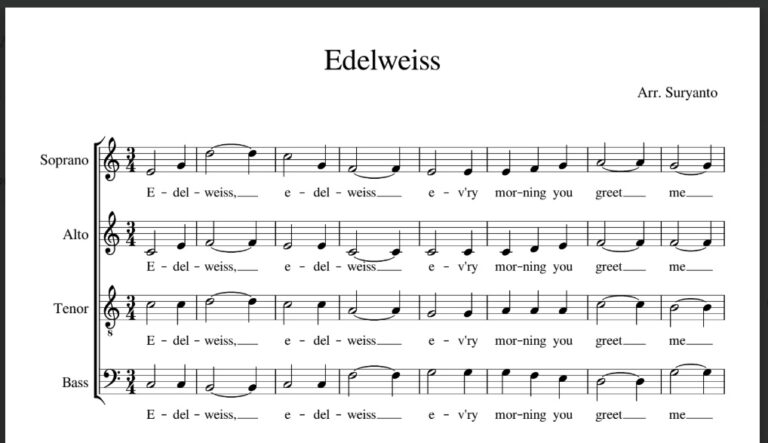
For choir music, we’re usually split into four sections – sopranos, altos, tenors, and basses. It’s commonly the women who are the “sops” and altos in a mixed choir, and the men are the tenors and basses. Some altos with a lower vocal range can quite happily sing the tenor parts. Some of the men will actually be baritones and sing somewhere in the middle of bass and tenor, not getting quite as low as the deepest bass note, nor as high as the highest tenor. More on vocal range here.
Anyway, the sheet music for a choir will usually have four sets of lines, the top five lines are for the sopranos, the five lines, known as a staff or stave, below that are for the altos. Those two staves will have a squiggly mark at the start of each called a treble clef. The two staves below those are for the tenors and the basses, and they have a backward C-shaped mark with two dots called a bass clef. The tenor stave is above the bass, because it’s higher. Sometimes, the tenor stave will have the treble clef squiggle with a little 8 underneath, which means it’s an octave lower, 8 whole notes in an octave.
So, top to bottom, we have four staves, each made up of five lines, for the soprano, alto, tenor, and bass parts. On those lines, we put marks, the notes, to correspond with the words we’re going to sing. Where those notes sit on the different lines of the staves represents how high or low the note is. Right at the top is the highest soprano note, it will even be drawn on with an extra couple of lines above the main five to show just how high it is. Right at the bottom is the deepest bass note, and again there will be extra lines drawn in below the usual bass five lines to represent exactly how low that note really is.
In between that low and that high are all the other notes, the doh-re-mi-fa-sol-la-ti-doh-re-mi-fa-sol-la…and so on getting higher and higher from bottom to top. Now, a quick aside, the doh-re-mi of the song, is like the C-D-E-F-G-A-B-C of the scale, but by calling them doh-re-mi instead, we can start our scale on a different note depending on the key of the song.
Where each note sits on a line or in between two lines in the stave tells us its pitch, how high or low it is. If you played this on the piano, you’d be using just the white notes. We’ll talk about the black notes, the notes in between the whites, the sharps and flats, another time.
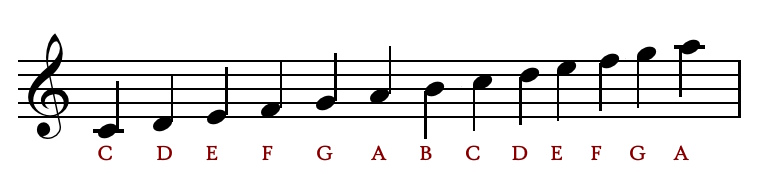
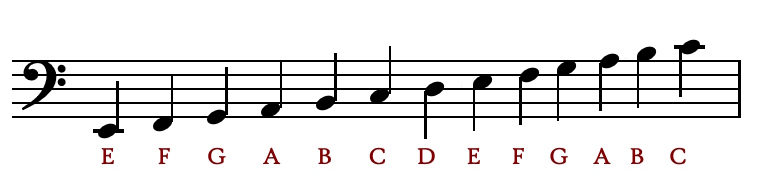
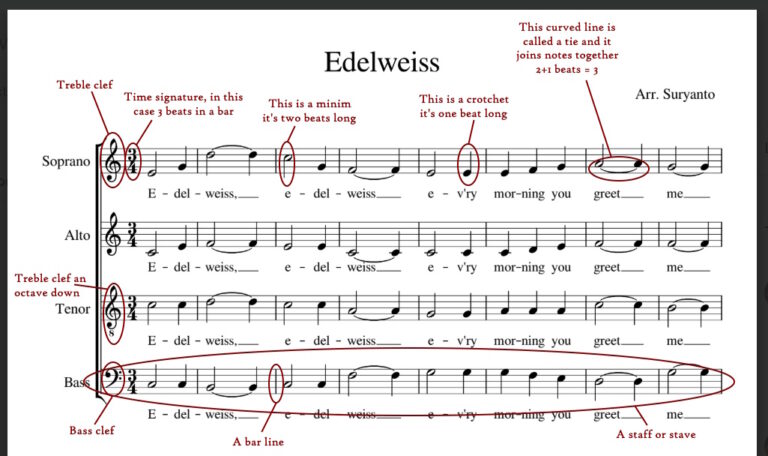
But, we need to know a little bit more about those dots and sticks on the packs of five lines, the staves, above the words of the song. If the position of the note up and down represents how high or low it is, then the shape of the note and whether it’s filled in or has a little tail on its stick represent how long the note is. If you take a look at this section of our sheet music for Edelweiss, I’ve marked it up to show you what the different terms I’ve used above refer to. I’ve separated out note lengths into a separate article, but they’re shown in the diagram below too.
TIME SIGNATURES
You might have spotted that some tunes, have a couple of numbers are the start of the staves For Edelweiss, there’s a 3 over a 4, that’s the song’s time signature, said out loud as 3 over 4, or just 3-4. This means there are three beats in the bar. The vertical lines in each stave, the bar lines (sometimes numbered), split the stave into bars and the notes within have to add up to the time signature. So, for Edelweiss, we can imagine tapping boom-cha-cha, across each bar as we sing the song, you’d get the feeling that it’s a waltz.
There are lots of basic time signatures, so 3 over 4 (three-four time) is waltz time, as we’ve seen. 2 over 4, is like a march – boom-cha, boom-cha… or left-right-left-right… if you like.
4 over 4, or 4-4, is the time signature that a lot of pop and rock are played in, the beats emphasised at different points in the bar for different styles, dance, reggae, heavy rock, whatever.
In classical choral music, you might encounter various other time signatures 3 over 8, 6 over 8 (which can be a folky kind of rhythm, as in The House of the Rising Sun.
There’s also 5 over 4, which is a compound time signature, it’s almost like a 2 over 4 with a 3 over 4 one after the other, like the Dave Brubeck jazz standard Take 5. You can count that as boom-cha-cha-boom-cha.
You might encounter other odd time signatures, like 7 over 4, seven beats in the bar, like the Peter Gabriel song Solsbury Hill and the verses of Pink Floyd’s Money. Progressive rock famously has even more complicated time signatures, like 9 over 8 or 9 over 4, and usually mixes a lot of different ones in a single piece of music, make it pretty much impossible to dance to, unless you have two left feet and a spare.
The famous intro to Mike Oldfield’s Tubular Bells, which was used as the theme tune for the film, The Exorcist, has a repeating pattern of two bars in 9/8 time followed by a third bar in 13/8 making it rather difficult to whistle!