A very short appendix to our introduction to musical notation explaining the relationship between note lengths.
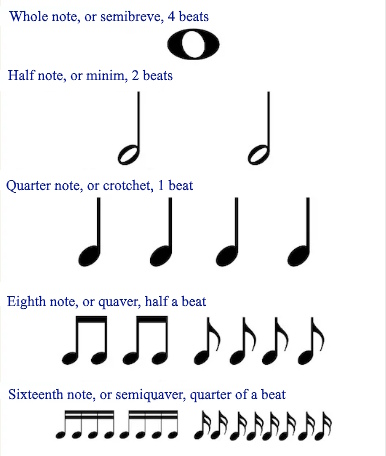
The semibreve is a whole note, it lasts for four beats. The minim, is a half note, and lasts for two beats. Two minims add up to a semibreve.
The crotchet, or quarter note, lasts for one beat, so two of those add up to a minim, four add up to a semibreve. So in 4/4 time they’re your count of 1, 2, 3, 4
Quavers are eighth notes, each is half the length of a crotchet. You need 8 of those to add up to the duration of a semibreve. You might count them as 1-and-2-and-3-and-4-and…
Semiquaver are half the length of the quavers, so there are 16 needed to add up to a semibreve, whole note. They have two tails on the individual notes.
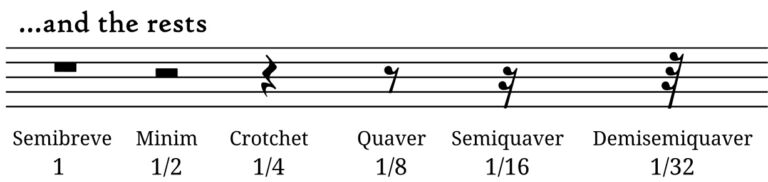
Rests
Each note length also has an equivalent “rest”. A rest is simply a bit where you don’t sing, your part, or sometimes, other parts are quiet wherever there’s a rest marked in your sheet music.
Dotted notes
If you see a dot immediately to the right of a note, then that means you hold the note for 50 percent of its value longer. So a dotted minim lasts 3 beats instead of 2, a dotted crotchet lasts one and a half beats, instead of 1, a dotted quaver lasts three quarters of a beat, and so on.
Even shorter notes
Oh, I’ve not put them in the diagram above, but we can have notes that are half the length of the semiquavers, these 32nd notes are called demisemiquavers and have three tails on the individual notes And, as you might have guessed, half again are 64th notes, hemidemisemiquavers, four tails.