The music and the musical director should be in full control of how a choir sounds. The sheet music guides the singers, but the MD is giving us the tempo, the pulse, the expression. All eyes on the MD and a choir can’t go wrong. There are some abbreviations and markings on sheet music that can help. Knowing what these mean will help you follow the MD much more effectively.
Musical notation, vocal range and SATB, intervals, and other stuff are covered elsewhere in the FEV Notes, but here’s a table showing the choir’s volume control. The two anchor words are piano (soft/quiet) and forte (strong/loud).
| Symbol | Italian Word | Meaning |
| pp | Pianissimo | Very soft |
| p | Piano | Soft |
| mp | Mezzo-piano | Moderately soft |
| mf | Mezzo-forte | Moderately loud |
| f | Forte | Loud; strong and bold |
| ff | Fortissimo | Very loud; full power |
Sections will be marked according to how the composer or the arranger, which might be the MD, wants a part to be sung. There might also be other markings that transition from quiet to loud (a crescendo, cresc.) sections or loud or soft (diminuendo, dim.). A crescendo is often marked with what is known colloquially as a hairpin, two long angled lines <. A diminuendo uses the hairpin but flipped backwards so that’s a long >. These marks can span a bar or several bars.
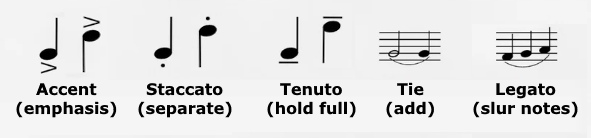
There might also be additional markings on specific notes (see the diagram above). An arrow, much shorter than the cresc./dim. hairpins, above or below a note tells you to give it more attack, to make the start of the note tighter, punchier.
A little dot above a note (or sometimes below it, depending on layout) tells us it is to be sung staccato (punchy, shorter than the usual length.
If there is a little dash above or below a note, it tells you to give it a bit extra, to hold it slightly longer than its marked rhythm, such a marking will be used to guide syncopation, where beat and rhythm are stretched and squashed to give the music the desired emotional impact.
A curved line joining notes together is called a tie. If it joins two notes of the same pitch, then you basically hold the note longer. If it joins two notes of different pitch, then it’s called a slur, and you are to steadily change the pitch from the first note to that of the next, you slide up or down to the second note.
Bonus marking: a small arrow pointing upwards (a caret) above a note tells you to basically make the note as punchy as possible, if not shout it!
Part of what individual members of a choir should be aiming for in following the MD and the sheet music is for their voice to blend with their section and for each section to work together to project the melodies and the harmonies. Unless there are solos in a choral piece, no voice should be heard above the others, and everyone’s voice should have a place in the overall sound. This is referred to as ensemble awareness.