We’re settling into the choir, and many are thinking about vocal range—how high and low they can sing—and how that fits into soprano, alto, tenor, or bass (SATB).
Finding your range
You can estimate your range using a piano (or similar instrument):
- Start around middle C and sing up the scale, stopping just before you need to strain. Note your highest comfortable pitch.
- Then sing down from the same starting point, noting your lowest comfortable pitch without losing strength.
You can do this at rehearsal or at home.
Understanding the scale
The basic scale in C major is C–D–E–F–G–A–B–C—an octave. Middle C is labelled C4. The C above is C5, then C6, and so on; below are C3, C2, etc. All notes follow this system (e.g. F#5, Bb3).
Typical choir ranges
In a community choir, voice parts usually sit within these ranges:
- Soprano: C4 to G5
- Alto: G3 to D5
- Tenor: C3 to G4
- Bass: G2 to D4
These are typical, not fixed. Your comfortable range may vary, and some pieces may sit higher or lower.
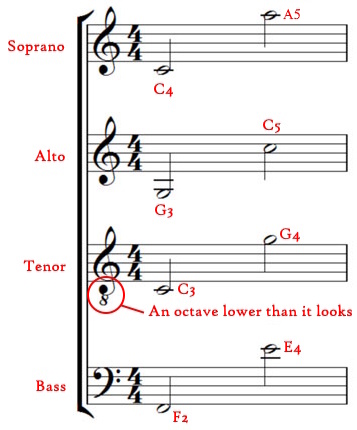
There is natural overlap between voice parts. Some altos can reach into the tenor range, some sopranos comfortably sing higher than typical choir lines, and baritones sit between bass and tenor. Some basses can also extend lower than standard ranges.
Don’t worry if you don’t cover the full range of your section. Never strain for a note, and don’t compare your range to others—some voices are naturally wider, and trained singers often develop larger ranges.
With time and good technique, your range may expand. As you become more confident and familiar with your voice, both your upper and lower limits can improve.
Typical extended ranges (classical context):
- Soprano: C4 to C6
- Alto: G3 to G5
- Tenor: C3 to C5
- Bass: E2 to C5
Across the choir, this spans roughly E2 to C6 (just over three octaves).
The key point: sing comfortably, avoid strain, and focus on blending with the choir. Your voice will develop naturally as you keep singing.
We have a section on singing technique and tips you might find useful.